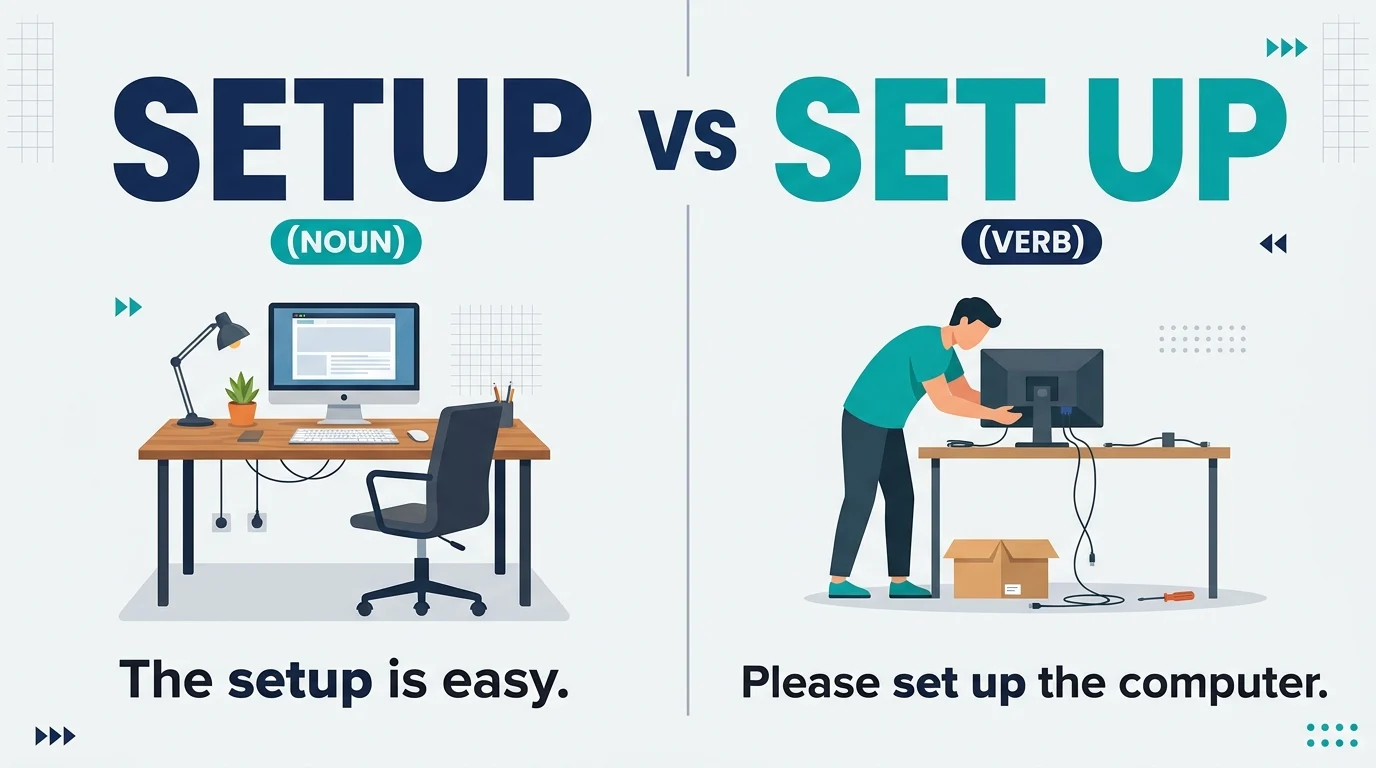
Have you ever wondered whether to write setup or set up? These two forms look almost identical, but they have different grammatical roles. Knowing when to use each one can make your English writing clearer, more natural, and more accurate. The good news is that the difference is easy to understand once you learn a simple rule.
The main difference between setup and set up is how each form works in a sentence. Setup is usually a noun or an adjective that describes an arrangement, configuration, or prepared system. Set up is a verb phrase that means to arrange, install, prepare, or establish something. For example, “The computer setup is simple” uses setup as a noun, while “I need to set up my computer” uses set up as a verb. Both forms are correct, but they cannot always replace each other. In this guide, you will learn their meanings, grammatical rules, common mistakes, and practical examples to help you choose the right form confidently.
Quick Answer: Setup vs Set Up
Setup is a noun or adjective, while set up is a verb phrase. Use setup when naming an arrangement, system, or configuration: “The setup is easy.” Use set up when describing an action, such as installing equipment or organizing an event: “Please set up the equipment.” Remember: one word names something; two words describe an action.
Why Do People Confuse Setup and Set Up?
People confuse these forms because they have similar spellings and related meanings. Both refer to arranging, preparing, or organizing something, but their grammatical functions are different.
English often uses related forms of a word in different ways. For example, login can be a noun, while log in is a verb phrase. Similarly, setup names an arrangement, while set up describes the act of creating that arrangement.
Here are two examples:
- Noun: The office setup looks professional.
- Verb: We need to set up the office.
In the first sentence, setup identifies the arrangement. In the second, set up describes an action.
What Does the First Word, “Setup,” Mean?
Setup is a noun or adjective that refers to an arrangement, configuration, system, or situation.
Setup as a noun
As a noun, setup names something that has been arranged or prepared.
Examples:
- The computer setup is excellent.
- Our classroom setup makes learning easier.
- The business has a simple payment setup.
- The camera setup includes three lights.
In these sentences, setup refers to an arrangement or configuration.
Setup as an adjective
Setup can also describe a noun, particularly in expressions related to equipment, preparation, or configuration.
Examples:
- I followed the setup instructions.
- The setup process takes five minutes.
- Read the setup guide before installing the software.
In everyday writing, setup is commonly used before nouns such as process, guide, and instructions.
What Does the Second Word, “Set Up,” Mean?
Set up is a verb phrase that means to arrange, install, prepare, organize, or establish something.
It usually describes an action that someone performs.
Set up meaning to arrange
Use set up when putting things in the right place or preparing them for use.
Examples:
- Please set up the chairs.
- We will set up the meeting room.
- She set up the table for dinner.
Set up meaning to install or configure
Use set up when preparing a device, account, or system so that it can work properly.
Examples:
- I need to set up my new phone.
- He set up an email account.
- They are setting up the computer network.
Set up meaning to establish
The phrase can also mean to start or establish an organization, business, process, or arrangement.
Examples:
- She plans to set up a small business.
- The school set up a scholarship program.
- We set up a meeting with the manager.
The past tense is set up, not setted up. The verb set has the same form in the present and past.
Setup vs Set Up: Comparison Table
| Feature | Setup | Set up |
|---|---|---|
| Grammatical role | Noun or adjective | Verb phrase |
| Main meaning | An arrangement or configuration | To arrange, install, or establish |
| Number of words | One | Two |
| Example | The setup is ready. | Set up the equipment. |
| Past tense | Not applicable as a noun | Set up |
| Common use | Setup guide, computer setup | Set up a computer, set up a meeting |
| Quick test | Can it be replaced by “arrangement”? | Can it be replaced by “arrange” or “install”? |
When Should You Use Setup or Set Up?
Choose the form that matches the job the word performs in your sentence.
Use “setup” when naming something
Choose setup when you are talking about an arrangement, system, or configuration.
Examples:
- The setup is complete.
- I like your gaming setup.
- This setup saves time.
- The camera setup looks professional.
A useful test is to replace setup with arrangement or configuration. If the sentence still makes sense, the noun form is probably correct.
Use “set up” when describing an action
Choose set up when someone is doing something to prepare or establish an arrangement.
Examples:
- Please set up the projector.
- I will set up your account.
- They set up a new office.
- We need to set up an appointment.
A useful test is to replace set up with arrange, install, or establish. If the meaning remains similar, the verb phrase is probably correct.
Compare both forms in one example
- Correct noun: The setup of the new office took two days.
- Correct verb: We set up the new office in two days.
The first sentence describes an arrangement or process as a thing. The second describes what people did.
12 Examples of Setup vs Set Up in Sentences
These examples show how both forms work in everyday English.
- Setup: My home office setup is comfortable.
- Set up: I need to set up my home office.
- Setup: The camera setup includes two microphones.
- Set up: The photographer will set up the cameras.
- Setup: The software setup was straightforward.
- Set up: Please set up the software on my laptop.
- Setup: Our classroom setup encourages teamwork.
- Set up: The teacher will set up the classroom before the lesson.
- Setup: The event setup looks impressive.
- Set up: Volunteers helped set up the event.
- Setup: The payment setup is convenient.
- Set up: You can set up automatic payments online.
Notice that setup names a thing or arrangement, while set up describes the action of creating or preparing it.
Common Mistakes With Setup and Set Up
Even fluent English speakers sometimes confuse these forms. Here are the mistakes to avoid.
Mistake 1: Using “setup” as a verb
Incorrect: I will setup my new laptop.
Correct: I will set up my new laptop.
Why? The sentence describes an action, so the two-word verb phrase is required.
Mistake 2: Using “set up” as a noun
Incorrect: The set up was easy.
Correct: The setup was easy.
Why? The sentence names an arrangement, so the one-word noun is appropriate.
Mistake 3: Writing “setted up”
Incorrect: She setted up an account yesterday.
Correct: She set up an account yesterday.
Why? Set is an irregular verb. Its present and past forms are the same.
Mistake 4: Assuming the meaning determines the spelling
Incorrect: The computer set up is confusing.
Correct: The computer setup is confusing.
Why? Even though both forms relate to preparing a computer, the sentence uses setup as a noun.
Mistake 5: Forgetting the difference in questions
Incorrect: How do I setup my account?
Correct: How do I set up my account?
Why? The phrase follows the auxiliary verb do and functions as the main verb of the question.
What Is an Easy Memory Trick for Setup vs Set Up?
Remember this simple rule:
One word = a thing. Two words = an action.
- Setup: A thing or arrangement. “My setup is ready.”
- Set up: An action. “I will set up my desk.”
You can also remember the phrase “setup is the result; set up is the action.” This is a helpful shortcut for most everyday situations.
For example, when you finish arranging your desk, you have a desk setup. While you are arranging it, you are setting it up.
Setup vs Set Up in American and British English
The distinction between setup and set up is generally the same in American and British English.
Both varieties use:
- Setup as a noun: “The office setup is convenient.”
- Set up as a verb: “We need to set up the office.”
Spelling differences between American and British English affect some words, such as color/colour and organize/organise, but they do not change this basic rule.
Whether you are writing an email, preparing a report, completing schoolwork, or creating website content, use setup for the noun and set up for the verb phrase.
Similar Words: Setup vs Set Up, Login vs Log In, and More
English contains several word pairs that follow the same pattern.
| Noun or adjective | Verb phrase | Example |
|---|---|---|
| Setup | Set up | The setup is ready. / Set up the equipment. |
| Login | Log in | The login failed. / Log in to your account. |
| Signup | Sign up | The signup process is easy. / Sign up today. |
| Backup | Back up | Keep a backup. / Back up your files. |
| Check-in | Check in | The check-in was quick. / Check in at reception. |
| Workout | Work out | My workout was short. / I work out daily. |
These pairs are useful because they show a common English pattern: a combined form may name a thing or process, while a separated form functions as a verb.
However, not every similar-looking pair follows exactly the same rules in every context. Check the grammatical role of the expression rather than relying only on its spelling.
Final Verdict: Which One Is Correct?
Both setup and set up are correct. The right choice depends on how you use the expression in a sentence.
- Use setup as a noun or adjective: “The setup is simple.”
- Use set up as a verb phrase: “I will set up the system.”
If you are naming an arrangement, choose setup. If you are describing the action of arranging, installing, preparing, or establishing something, choose set up.
Frequently Asked Questions
1. Is setup one word or two words?
Setup is one word when used as a noun or adjective. Set up is two words when used as a verb phrase. For example, “The setup is complete” and “We will set up the equipment” are both correct.
2. Is it “setup an account” or “set up an account”?
The correct phrase is “set up an account.” It describes the action of creating or configuring an account. For example: “I need to set up an account before using the service.”
3. Is setup a noun or a verb?
Setup is primarily a noun and can also function as an adjective. It is not the standard verb form for this meaning. The verb phrase is set up.
4. What is the past tense of set up?
The past tense is set up. The verb set does not change in the past tense. For example: “She set up the meeting yesterday.” Do not write setted up.
5. Is it “setup process” or “set up process”?
“Setup process” is the usual form when setup describes the process as a noun modifier. For example: “Follow the setup process carefully.” You would write “the process to set up the device” when using the verb phrase.
6. Is “set-up” with a hyphen correct?
Set-up appears in some British English writing and in certain established usages, particularly as a noun. However, setup is widely used as the standard one-word noun, while set up is the standard verb phrase. Follow the style guide used by your school or workplace.
7. How do I remember the difference between setup and set up?
Remember: a setup is a thing; to set up is to do something. For example, “My gaming setup looks great” names an arrangement, while “I will set up my gaming computer” describes an action.
Remember This
- Setup = a noun or adjective.
- Set up = a verb phrase.
- The setup is ready. Names an arrangement.
- Set up the computer. Describes an action.
- Set up has the same form in the present and past: “I set up the account yesterday.”
Conclusion
Understanding setup vs set up is easier when you focus on grammar rather than meaning alone. Although both expressions relate to preparing or arranging something, setup names an arrangement or configuration, while set up describes the action of creating or preparing it. This distinction applies to computers, offices, meetings, accounts, events, and many other everyday situations.
The next time you write one of these expressions, ask yourself whether you are naming something or describing an action. If you are naming an arrangement, write setup. If you are describing an action, write set up. With this simple rule and a little practice, you can use both forms naturally and confidently in everyday English.
Clarify adjective usage and hyphenationTighten repeated explanations throughout