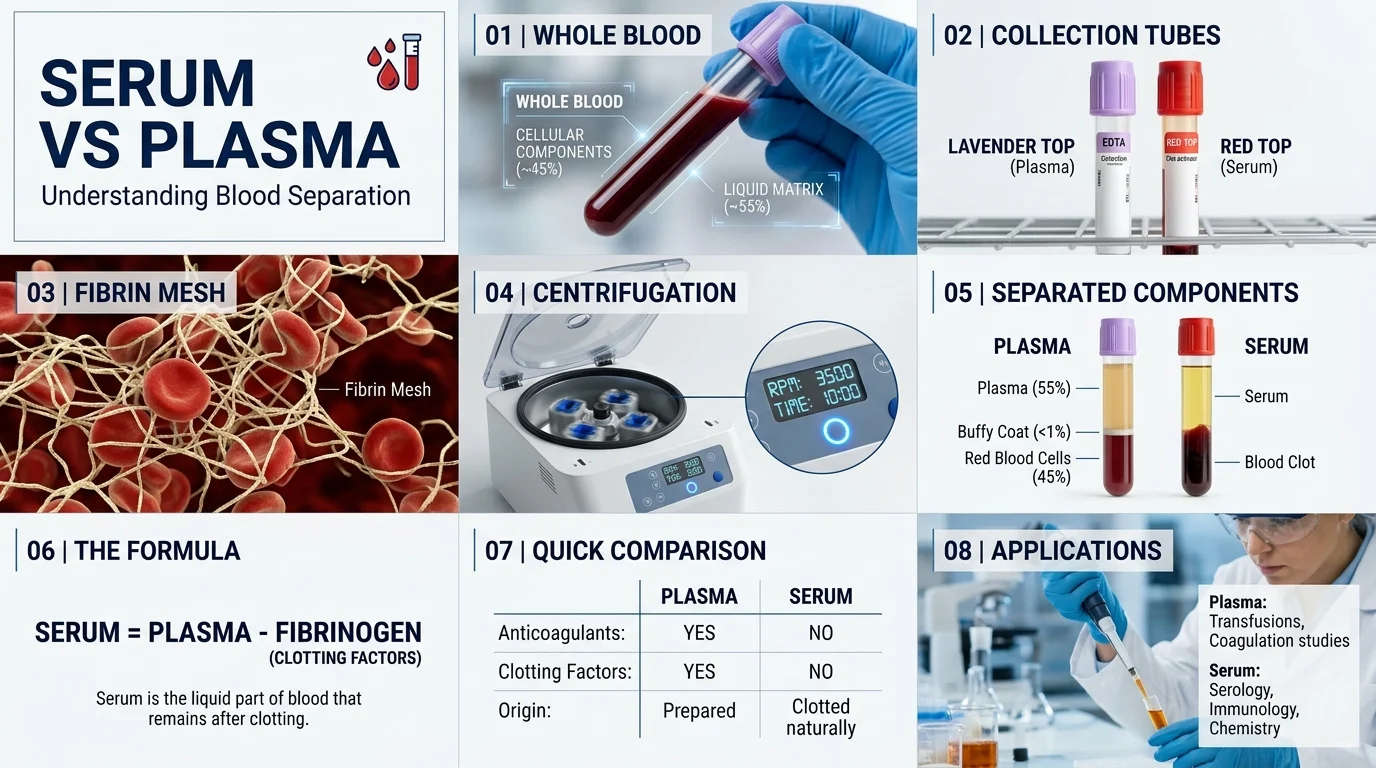
If you’ve ever seen a blood test report, you’ve probably noticed the words serum and plasma. They sound similar because both come from blood, but they are not the same thing. The biggest difference is simple: plasma contains clotting proteins, while serum does not. This small difference changes how doctors and laboratories use each one.
Understanding serum vs plasma is important for students, healthcare learners, and anyone curious about blood tests. In this guide, you’ll learn what each term means, how they are different, when each is used, and how to remember the difference with easy examples.
Quick Answer
Serum is the liquid part of blood after it has clotted, so it does not contain clotting factors like fibrinogen. Plasma is the liquid part of blood before clotting and still contains clotting proteins. Plasma is commonly used for clotting tests, while serum is widely used for routine blood tests.
Why People Confuse Serum and Plasma
People often mix up these words because:
- Both are the liquid portion of blood.
- Both are used in medical laboratories.
- Both are yellow or straw-colored.
- They contain water, proteins, hormones, and nutrients.
The key difference is whether the blood has clotted before the liquid is separated.
What Is Serum?

Serum is the clear yellow liquid that remains after blood has formed a clot.
When blood is collected and allowed to clot naturally, the clot traps blood cells and clotting proteins. After spinning the sample in a centrifuge, the remaining liquid is called serum.
What serum contains
- Water
- Electrolytes
- Hormones
- Antibodies
- Enzymes
- Proteins (except most clotting proteins)
What serum does not contain
- Fibrinogen
- Most clotting factors
Common uses of serum
- Cholesterol tests
- Liver function tests
- Kidney function tests
- Antibody testing
- Hormone testing
What Is Plasma?

Plasma is the liquid part of blood before clotting happens.
To obtain plasma, blood is collected into a tube containing an anticoagulant, which prevents clotting. After centrifugation, the plasma separates from the blood cells.
What plasma contains
- Water
- Electrolytes
- Nutrients
- Hormones
- Antibodies
- Fibrinogen
- Other clotting factors
Common uses of plasma
- Blood clotting tests
- Emergency plasma transfusions
- Coagulation studies
- Medical research
Serum vs Plasma Comparison Table
| Feature | Serum | Plasma |
|---|---|---|
| Definition | Liquid after blood clots | Liquid before blood clots |
| Clotting factors | Mostly absent | Present |
| Fibrinogen | No | Yes |
| Collection | Blood allowed to clot | Blood collected with anticoagulant |
| Color | Straw-yellow | Straw-yellow |
| Used for | Routine blood tests | Clotting tests and transfusions |
| Contains antibodies | Yes | Yes |
| Laboratory preparation | Clot first, then centrifuge | Centrifuge immediately |
When Should You Use Serum or Plasma?
Use serum when
- Checking cholesterol levels
- Measuring hormones
- Testing antibodies
- Evaluating liver function
- Measuring kidney function
Use plasma when
- Performing clotting tests
- Studying coagulation disorders
- Giving plasma transfusions
- Measuring clotting proteins
10+ Examples of Serum and Plasma
These examples show how each term is used in real life.
Serum examples
- The doctor ordered a serum cholesterol test.
- The lab measured serum glucose.
- A serum pregnancy test confirmed the result.
- Scientists examined serum antibodies.
- The patient’s serum calcium level was normal.
- The nurse collected blood for a serum hormone test.
Plasma examples
- The patient received a plasma transfusion.
- The laboratory performed a plasma clotting test.
- Doctors measured plasma fibrinogen levels.
- Researchers analyzed plasma proteins.
- Blood banks store fresh frozen plasma.
- The emergency team requested plasma for treatment.
Common Mistakes
Many beginners make these mistakes:
Mistake 1: Thinking serum and plasma are identical.
– Correct: Plasma contains clotting factors; serum does not.
Mistake 2: Assuming both are collected the same way.
– Correct: Serum requires clotting first, while plasma uses an anticoagulant.
Mistake 3: Using serum for clotting tests.
– Correct: Plasma is preferred because it still contains clotting proteins.
Memory Trick
A simple way to remember the difference is:
- Plasma = Plus clotting proteins.
- Serum = Stops after clotting.
Another easy phrase is:
Plasma keeps the clotting proteins; serum leaves them behind.
American vs British English
Good news—there is no spelling difference between American and British English.
| American English | British English |
|---|---|
| Serum | Serum |
| Plasma | Plasma |
Both countries use the same medical terms.
Similar Words
These related terms are often seen with serum and plasma.
| Word | Meaning |
|---|---|
| Blood | The fluid that circulates through the body |
| Fibrinogen | A clotting protein found in plasma |
| Platelets | Blood cells that help form clots |
| Antibodies | Proteins that help fight infections |
| Coagulation | The process of blood clotting |
| Centrifuge | A machine that separates blood components |
Final Verdict
Serum and plasma both come from blood, but they serve different purposes.
- Choose serum for most routine laboratory tests because the blood has already clotted.
- Choose plasma when clotting factors need to remain available, especially for coagulation tests and transfusions.
Remember the key rule:
Plasma contains clotting proteins. Serum does not.
Frequently Asked Questions
Is serum the same as plasma?
No. Serum is blood’s liquid after clotting, while plasma is the liquid before clotting and still contains clotting factors.
Which contains fibrinogen?
Plasma contains fibrinogen. Serum does not because fibrinogen is used during clot formation.
Why is plasma used for clotting tests?
Plasma keeps clotting proteins intact, making it suitable for tests that measure how blood clots.
Why is serum used for routine blood tests?
Serum provides a stable sample for many tests, including cholesterol, hormones, and antibody measurements.
What color are serum and plasma?
Both are usually straw-yellow, although slight differences may appear depending on the sample.
Can plasma become serum?
Yes. If plasma is allowed to clot and the clotting proteins are removed, the remaining liquid is essentially serum.
Which is used in blood transfusions?
Plasma, especially fresh frozen plasma, is commonly used in transfusions to replace clotting factors.
Remember This
Keep these three points in mind:
- Serum = After clotting.
- Plasma = Before clotting.
- Plasma contains fibrinogen; serum does not.
Conclusion
Serum and plasma are closely related but have distinct roles in medicine and laboratory testing. Their main difference comes down to clotting: plasma keeps clotting proteins, while serum is what remains after those proteins have done their job. Knowing this makes it much easier to understand blood tests and medical terminology.
Whether you’re studying biology, preparing for an exam, or simply reading a lab report, remembering the phrase “Plasma has clotting proteins; serum does not” will help you quickly tell them apart and understand why each is used in different situation.